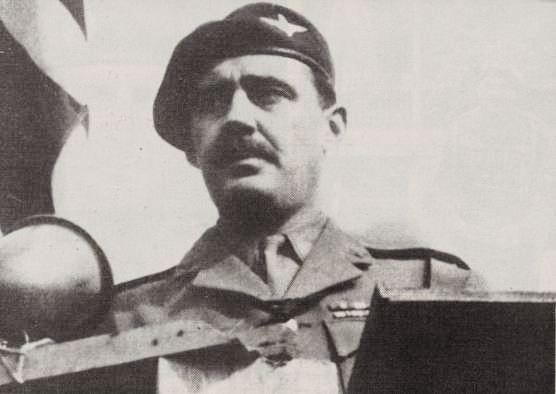
LTC John Frost speaking to the people of Arnhem in 1945 at the unveiling of a monument to commemorate the bridge action. Copyright: Imperial War Museum.
This is one of the coolest interviews/television shows I've ever seen: "This Is Your Life; Major General John Frost" It covered his military career and campaigns from Feb '42, Operation Biting in Bruneval, France, North Africa/Tunisian campaign, Sicily and the Italian campaign, to his capture at Arnhem September '44. If you've studied the 1st Para Brigade you'll hear many familiar names- I loved seeing Major General Frost reunited with men from every time and place he fought during the War; even his German counterpart! The audio is out of sync in Part 2, but still well worth the watch:
"Marines storm Tarawa. Gilbert Islands." WO Obie Newcomb, Jr., November 1943. 127-N-63458.
Alexander Bonnyman, Jr. is the 4th man on the right at the top of the bunker (denoted with a faint arrow by the Marine Corps photographer, Obie Newcomb).
Lt Alexander Bonnyman earned the MOH during actions on Tarawa 20-22 November 1943, where he was KIA 22 November 1943. Much has been written about Lt Bonnyman in recent months due to the relentless work of his family in finding his body after 3 dozen unidentified Marines from Tarawa were returned to the US, where his remains were interred in Knoxville, TN September 2015. He had erroneously been listed as buried at sea in 1943.
Below is Lt Bonnyman's MOH citation, and of course you can read up on the details of his life and death and unique reburial on many websites.
"For conspicuous gallantry and intrepidity at the risk of his life above and beyond the call of duty as Executive Officer of the 2d Battalion Shore Party, 8th Marines, 2d Marine Division, during the assault against enemy Japanese-held Tarawa in the Gilbert Islands, 20-22 November 1943. Acting on his own initiative when assault troops were pinned down at the far end of Betio Pier by the overwhelming fire of Japanese shore batteries, 1st Lt. Bonnyman repeatedly defied the blasting fury of the enemy bombardment to organize and lead the besieged men over the long, open pier to the beach and then, voluntarily obtaining flame throwers and demolitions, organized his pioneer shore party into assault demolitionists and directed the blowing of several hostile installations before the close of D-day. Determined to effect an opening in the enemy's strongly organized defense line the following day, he voluntarily crawled approximately 40 yards forward of our lines and placed demolitions in the entrance of a large Japanese emplacement as the initial move in his planned attack against the heavily garrisoned, bombproof installation which was stubbornly resisting despite the destruction early in the action of a large number of Japanese who had been inflicting heavy casualties on our forces and holding up our advance. Withdrawing only to replenish his ammunition, he led his men in a renewed assault, fearlessly exposing himself to the merciless slash of hostile fire as he stormed the formidable bastion, directed the placement of demolition charges in both entrances and seized the top of the bombproof position, flushing more than 100 of the enemy who were instantly cut down, and effecting the annihilation of approximately 150 troops inside the emplacement. Assailed by additional Japanese after he had gained his objective, he made a heroic stand on the edge of the structure, defending his strategic position with indomitable determination in the face of the desperate charge and killing 3 of the enemy before he fell, mortally wounded. By his dauntless fighting spirit, unrelenting aggressiveness and forceful leadership throughout 3 days of unremitting, violent battle, 1st Lt. Bonnyman had inspired his men to heroic effort, enabling them to beat off the counterattack and break the back of hostile resistance in that sector for an immediate gain of 400 yards with no further casualties to our forces in this zone. He gallantly gave his life for his country."
See more info here: http://www.cmohs.org/recipient-…/…/bonnyman-alexander-jr.php
"No.4 Company, 1st.Welsh Guards, in action near Cagny, Caen, Normandy during 'Operation Goodwood'. 19th of July 1944. The Company Commander, Maj J. D. A. Syrett, is seen indicating a mortar target to Sgt Veysey. Gdsm Kitchen is in the foreground and Gdsm Fenwick is the Bren gunner. Major Syrett was killed a few days later."
LEFT: Major JDA Syrett's grave RIGHT: Paperwork for JDA Syrett's gravestone KIA July 22, 1944
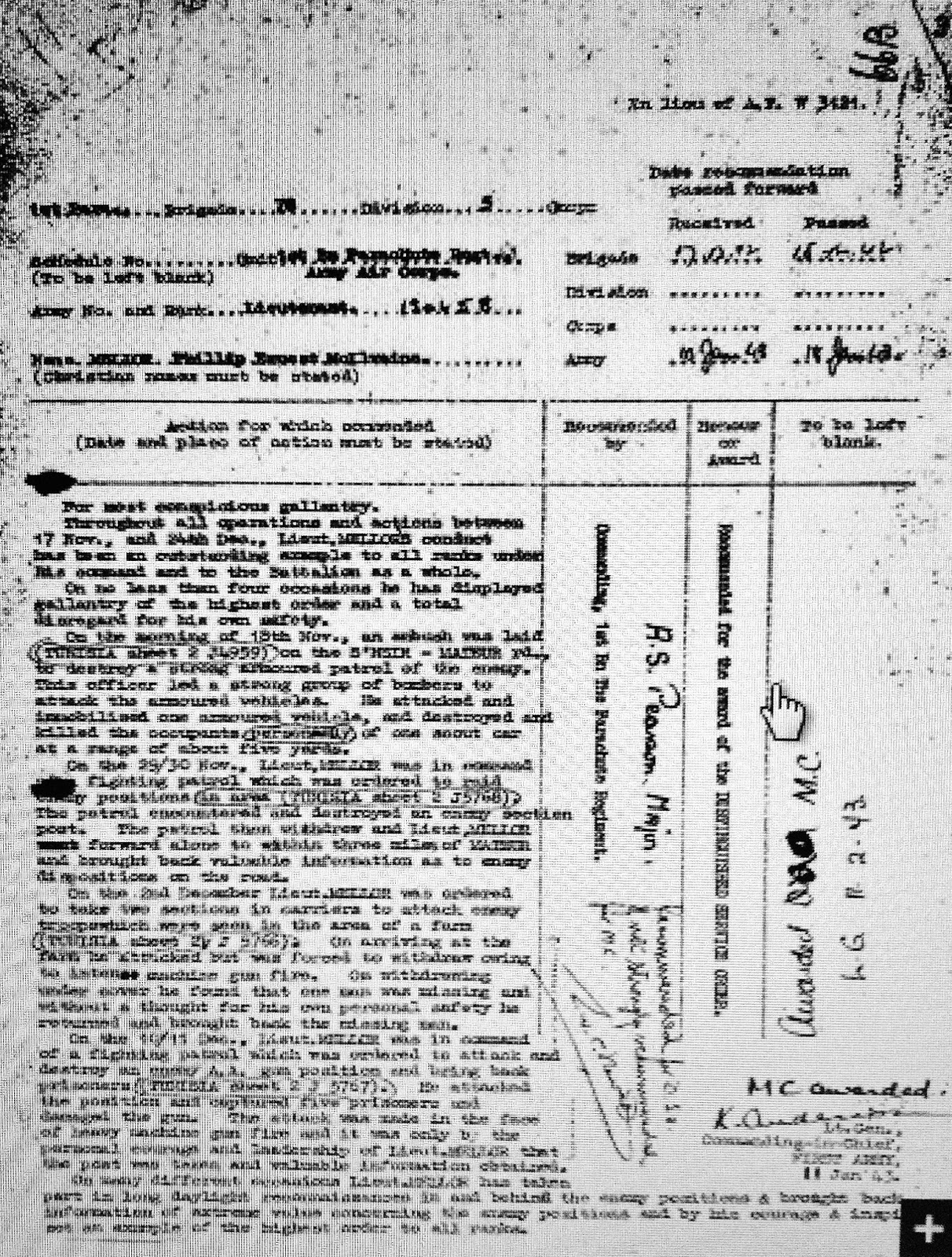
Service Portrait Lt Philip Mellor, Courtesy Paradata.org.uk
"There are many individual acts of heroism, but one became almost a legend in the brigade and concerned Captain* Mellor of 'T' Company. This officer was a well-known figure with his black patch over a blind eye and already had a great reputation for courage and incredible daring. During an assault his company was held up by three enemy machine-gun posts. At once he raced forward alone and destroyed them all, one by one, with grenades and as Schmeisser tommy-gun taken from a dead German. Soon afterwards his men saw him cut down by an anti-personnel mine.
'Don't stop, chaps!' he shouted in a matter of fact voice. 'Go on!
I'm afraid I can't come with you! I've lost a leg!'
MEDJEZ-EL-BAB Cemetery, located 60 km west of Tunis Courtesy of aucklandmuseum.com
He would allow no one to stay with him, for any wavering in the final rush would have been fatal. When the stretcher-bearers found him after the position was won he was dead."
Lt. Jack Butler of the 82nd Chemical Mortar Battalion with Filipino guerrilla Ricardo Gimotea sometime after Shimbu Line was broken around June 20, 1945. Ric and his cousin Jose had been fighting the Japanese for three years when they joined 2nd plt of the 82nd CMB. They were expert linesmen through difficult terrain, and described as "courageous and willing" warriors.
- WWII Files
May 21, 2016, with research from Lt Col (Ret.) Jack Butler's memoirs and recollections
Commemorating Liberation Day Netherlands 5.5.1945
Even though this photo was 6 months before Liberation Day, it shows the
bond between a Dutch family and Canadian trooper who is there to fight
for their freedom.
"Lance-Corporal Harry Repay of the Scout
Platoon, South Saskatchewan Regiment, visiting a Dutch family in their
home near Nijmegen, Netherlands, 8 December 1944. Photographer: Dean, Michael M. Location: Nijmegen, Netherlands" Courtesy Library and Archives Canada
"Lance-Corporal J.A. Thrasher of The Westminster Regiment (Motor), who holds the PIAT anti-tank weapon with which he disabled the German self-propelled 88mm. gun on which he is sitting, near Pontecorvo, Italy, 26 May 1944."
(Photographer: Smith, Strathy E.E. Courtesy of Library and Archives Canada) James Alton Thrasher was soon promoted to Sargent but was killed in action about 7 months after this photo was taken on December 11, 1944.September 8, 1917 - December 11, 1944 Service Number: K/49637 Age: 27 Force: Army Unit: Westminster Regiment (Motor) Citation(s): 1939-45 Star, Italy Star, War Medal, Canadian Volunteer Service Medal and Clasp.
WWII Westminster Regiment badge in WWIIFiles collection