Wednesday, November 30, 2016

Losses of HQ and HQ Co, 67th Armored Regiment, 2nd Armored Division- July 29, 1944

Recently, I was gifted with a copy of History of the 67th Armored Regiment of the famous 'Hell on Wheels' 2nd Armored Division. It was owned by a friend's father, Gilbert White, who fought with the 67th in HQ and HQ Company.  It was published in Brunswick, Germany in 1945, just after the War ended.  The inscription on the front was where Gilbert White signed his name and hometown, claiming his personal copy.  This is a 407 page volume detailing the regiment from North Africa to The Elbe in Germany, with each battalion, HQ, Reconnaissance, Maintenance, and Service Companies getting their individual histories recorded.  There are also dozens of pages photographs, the entire regiment's roster (November 1942- May 1945) with decoration and KIA notations, and large, full-colour, fold out maps in the back of the book.  To say the book is a treasure is an understatement.  
Despite  Headquarters and Headquarters Company being with the regiment from it's first action in North Africa, November 1942, they did not have any casualties until 20 months later. Oddly, this company, while belonging to arguably our nation's fiercest armored division in WWII, did not lose a man at the rate other's were lost in the regiment in North Africa, Italy, or the Normandy campaign.   
HQ and HQ Co sailed for Normandy the night of June 10, 1944.  June 16th (1944) "the company experienced their first enemy artillery fire.  There were no casualties although several shells landed in the area perforating C.W.O. Hobbs tent and a piece of shrapnel piercing Pvt. Mc.Coys helmet that was lying next to him.  The next morning slit trenches were on an average of two feet deeper." (p.317). 
"...On the 21st of July all officers were carefully briefed on the coming operation.  The large plan involved the smashing of the enemy crust in a concentrated bombing attach, after which the 9th and 30th Infantry Divisions were to roll back the flanks and the Second and Third Armored DIvision and 1st Infantry Divisions poured through the center." (p.319) This was the battle plan for Operation Cobra to begin July 25, 1944.
The history takes up a couple of days into Operation Cobra, 
"The next afternoon (27 July) the company was again on the move, passing through the devastated country side that had been the scene of the bombing attack.  Not a living thing was to be found along the way.  Dead horses and cattle lay everywhere along with wrecked German vehicles and dead Germans.  A little further on the burnt out hulls of American tanks were seen and occasionally a dead American Infantryman. ... At daylight the next morning they were just outside of Notre Dame de Cenilly.  Small arms fire could be heard up ahead and the company pulled off the road until about 1100 then proceeded on through Notre Dame and halted again just south of town, still on the road.  The Krauts began shelling the town so the Company moved a few hundred yards down the road.  Shortly after that Captain Sanborn arrived at the scene with orders to move back and clear the road.  The Company turned around and moved to an orchard just east of town." (p. 319). 
The next bit of action is stunning and and unexpected.
"The next morning the company moved about three miles further south and pulled off the road.  Nearly all the vehicles were in the bivouac when the Medical Detachment half-track pulled over the swing into the field.  It ran over a pile of sixteen anti-tank mines left there the night before by part of the 4th Infantry.  A terrific explosion occurred, instantly killing Major Montfort Smith, Technician fifth grade McKay, a motorcycle rider from Second Battalion, two men from the 4th Infantry Division and two civilians.  Captain Sanborn was critically injured and died on the way to the hospital.  Captain Raffington, Technical Sergeant Wallace, Technician fourth grade Roberts, Technician fifth grade Dimock, Private Wiggins, Sergeant Hafner, and Technician fifth grade Cordell of the Medical Detachment and Private 1st class Garret and Private 1st class Willinghan of the company were seriously injured.  These were the first casualties suffered by Headquarters and Headquarters Company and their loss was keenly felt by their many friends and buddies in the Company." (p. 320). 

What a bitter pill to swallow.

UPDATE AUGUST 2018: 
In August 2018, I led a Western European tour in the footsteps of the 22nd Infantry Regiment, 4th Infantry Division.  While in Normandy, we spent part of an afternoon at the American Memorial Cemetery in Colleville-Sur-Mer, Normandy.  Because I had spent the year working on the finer points of my tour and history of the 22ndIR, I was not looking for particular soldiers of other regiments buried in Normandy.  While walking among the thousands of graves, however, the location of where Cpt Oliver True Sanborn was resting stopped me dead in my tracks.  Covered in goosebumps, the photos of him I've seen, and his story washed over me.  Two years before I had written this article about him.  It was a full circle moment to accidentally walk right upon him. In the many years I've working on research projects, the ways that certain stories come to me in serendipitous and providential ways have been nothing short of incredible.  It has been true to my experience that even many decades after the events, certain men and stories are crying out to be discovered, heard, and known.   


Oliver True Sanborn, Jr.- his senior portrait and quote at Portland High School, ME
He was the Captain of  his high school army cadets
He is buried at 
Plot E Row 28 Grave 26,
Normandy American Cemetery
Bronze Star, Purple Heart


Captain Oliver True Sanborn Jr. is buried in the Collville Sur Mer cemetery in Normandy, as is Tec5 John W. MacKay (spelled wrong in the regtl history).  Major Montfort Smith is buried in Arlington National Cemetery.  SEE UPDATE ABOVE ON THE STORY OF THIS GRAVE PHOTO. (Aug. 2018)


Tec 5 John W. MacKay's body internment paperwork
Plot E Row 17 Grave 26,
Normandy American Cemetery
Purple Heart


Montfort Smith, 1934, a Junior
at the University of Illinois
Major Smith is buried at
Arlington Natl Cemetery,
Section 12, Grave 5228


~~NOVEMBER 30, 2016
WWIIFILES

Thursday, October 6, 2016

Happy Birthday PFC REGIS GALLAGHER; 672nd Amphibian Tractor Battalion- October 6, 1923- June 21, 2008

I am happy to have happened upon an extensive photo album and WWII diary of PFC Regis Gallagher. I am proud to have a photo record of a little known unit, the 672nd Amphibian Tractor Battalion. He spent time on Bougainville attached to the 37th Infantry Division, preparing for the invasion of Luzon, Philippines.  He hit the beach January 9, 1945 with the 37th Infantry Division and fought all the way to Manila.  On February 23, 1945 his unit made the amphibious attack on the Los Banos internment camp.  Afterwards, his unit was shipped to Morati where they trained with the Australian 7th Army.  They sailed to Borneo and hit the beach July 1, 1945, where they fought for two weeks with the Australians in the last major Allied campaign in the Pacific. 
More of his diary will be published and more men in his unit shared, but until then; here are a couple photos of PFC Gallagher, remembering him 93 years after his birth.
Regis Gallagher; October 6, 1923- June 21, 2008
~~WWIIFILES
October 6, 2016

"ME- (Combat outfit), Luzon, Philippines March 1945"

"MY ALLIGATOR"

Tuesday, August 23, 2016

WWIIPOD: Waffen SS at Rest in Soviet Countryside; 1941


SS soldiers resting at a fence in the Soviet countryside. The soldier in the foreground on the left is armed with MP-38.

Monday, August 8, 2016

1st Battalion, 2nd Independent Parachute Brigade drop on Megara, Greece, October 12/13, 1944- Operation Manna

1st Battalion, 2nd Independent Parachute Brigade dropped on Megara, Greece, October 12/13 1944


     This was part of Operation Manna (mid October 1944 to mid January 1945), from October 12/13 when one company of 4th Para Bn was dropped onto the Megara Airfield at the operation's onset. 
British units (5th and 6th Para Bn, and parts of the 2nd and 4th Para Regiments) were tasked with multi-faceted missions in Greece, "harrassing the anticipated German withdrawal from the Balkans", street fighting while keeping political order as Civil War developed in Athens, while providing basic food and supplies to the tens of thousands of civilians living among the chaos. 
     "5th Para Bn suffered over 100 casualties and 6th Para Bn lost all it's company commanders in fighting widely misunderstood by press and public opinion back home. The task was successfully completed by January 1945. The irony of the deployment was encapsulated by the final day's fighting in Athens when the Brigade had killed 170 rebels, wounded 70 and captured 520 while concurrently feeding 20,000 civilians each day."
(Quotes from ParaData.Org.UK)

Thursday, July 21, 2016

Legendary Major General John Frost "THIS IS YOUR LIFE" episode; 20 years post WWII


LTC John Frost speaking to the people of Arnhem in 1945 at the unveiling of a monument to commemorate the bridge action. Copyright: Imperial War Museum.
     This is one of the coolest interviews/television shows I've ever seen: 
"This Is Your Life; Major General John Frost"
It covered his military career and campaigns from Feb '42, Operation Biting in Bruneval, France, North Africa/Tunisian campaign, Sicily and the Italian campaign, to his capture at Arnhem September '44. If you've studied the 1st Para Brigade you'll hear many familiar names- I loved seeing Major General Frost reunited with men from every time and place he fought during the War; even his German counterpart! The audio is out of sync in Part 2, but still well worth the watch:


Tuesday, June 28, 2016

Lt Alexander Bonnyman, MOH recipient, KIA 22 November 1932, Tarawa, Gilbert Islands- Grave Visit, Knoxville, TN


"Marines storm Tarawa. Gilbert Islands." WO Obie Newcomb, Jr., November 1943. 127-N-63458.

Alexander Bonnyman, Jr. is the 4th man on the right at the top of the bunker (denoted with a faint arrow by the Marine Corps photographer, Obie Newcomb).


     Lt Alexander Bonnyman earned the MOH during actions on Tarawa 20-22 November 1943, where he was KIA 22 November 1943. Much has been written about Lt Bonnyman in recent months due to the relentless work of his family in finding his body after 3 dozen unidentified Marines from Tarawa were returned to the US, where his remains were interred in Knoxville, TN September 2015. He had erroneously been listed as buried at sea in 1943. 
     Below is Lt Bonnyman's MOH citation, and of course you can read up on the details of his life and death and unique reburial on many websites.


"For conspicuous gallantry and intrepidity at the risk of his life above and beyond the call of duty as Executive Officer of the 2d Battalion Shore Party, 8th Marines, 2d Marine Division, during the assault against enemy Japanese-held Tarawa in the Gilbert Islands, 20-22 November 1943. Acting on his own initiative when assault troops were pinned down at the far end of Betio Pier by the overwhelming fire of Japanese shore batteries, 1st Lt. Bonnyman repeatedly defied the blasting fury of the enemy bombardment to organize and lead the besieged men over the long, open pier to the beach and then, voluntarily obtaining flame throwers and demolitions, organized his pioneer shore party into assault demolitionists and directed the blowing of several hostile installations before the close of D-day. Determined to effect an opening in the enemy's strongly organized defense line the following day, he voluntarily crawled approximately 40 yards forward of our lines and placed demolitions in the entrance of a large Japanese emplacement as the initial move in his planned attack against the heavily garrisoned, bombproof installation which was stubbornly resisting despite the destruction early in the action of a large number of Japanese who had been inflicting heavy casualties on our forces and holding up our advance. Withdrawing only to replenish his ammunition, he led his men in a renewed assault, fearlessly exposing himself to the merciless slash of hostile fire as he stormed the formidable bastion, directed the placement of demolition charges in both entrances and seized the top of the bombproof position, flushing more than 100 of the enemy who were instantly cut down, and effecting the annihilation of approximately 150 troops inside the emplacement. Assailed by additional Japanese after he had gained his objective, he made a heroic stand on the edge of the structure, defending his strategic position with indomitable determination in the face of the desperate charge and killing 3 of the enemy before he fell, mortally wounded. By his dauntless fighting spirit, unrelenting aggressiveness and forceful leadership throughout 3 days of unremitting, violent battle, 1st Lt. Bonnyman had inspired his men to heroic effort, enabling them to beat off the counterattack and break the back of hostile resistance in that sector for an immediate gain of 400 yards with no further casualties to our forces in this zone. He gallantly gave his life for his country."

See more info here: http://www.cmohs.org/recipient-…/…/bonnyman-alexander-jr.php


Friday, June 17, 2016

WWIIPOD: 1st Welsh Guards, near Cagny, Caen, Normandy, July 19, 1944

Colourised image © Welsh Guards Archives / Tom Marshall 2014. All rights reserved.


"No.4 Company, 1st.Welsh Guards, in action near Cagny, Caen, Normandy during 'Operation Goodwood'. 19th of July 1944. 

The Company Commander, Maj J. D. A. Syrett, is seen
indicating a mortar target to Sgt Veysey. 
Gdsm Kitchen is in the foreground and Gdsm Fenwick is the Bren gunner. 
Major Syrett was killed a few days later."


LEFT:  
Major JDA
Syrett's grave

RIGHT:   Paperwork for 
JDA Syrett's gravestone
KIA July 22, 1944

Friday, June 3, 2016

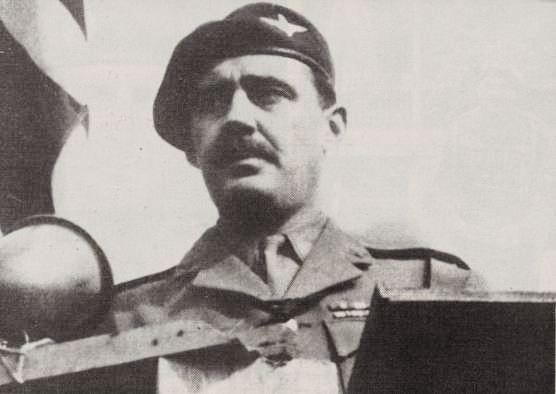
Lt Philip E. Mellor 1st Parachute Brigade, KIA During the Battle of Djebel Mansour- February 5, 1903- February 3, 1943


Service Portrait Lt Philip Mellor,
Courtesy Paradata.org.uk
"There are many individual acts of heroism, but one became almost a legend in the brigade and concerned Captain* Mellor of 'T' Company.  This officer was a well-known figure with his black patch over a blind eye and already had a great reputation for courage and incredible daring.  During an assault his company was held up by three enemy machine-gun posts.  At once he raced forward alone and destroyed them all, one by one, with grenades and as Schmeisser tommy-gun taken from a dead German.  Soon afterwards his men saw him cut down by an anti-personnel mine. 
     'Don't stop, chaps!' he shouted in a matter of fact voice.  'Go on! 
I'm afraid I can't come with you!  I've lost a leg!'


MEDJEZ-EL-BAB Cemetery, located 60 km west of Tunis
Courtesy of aucklandmuseum.com
     He would allow no one to stay with him, for any wavering in the final rush would have been fatal.  When the stretcher-bearers found him after the position was won he was dead."  
~~"Wings of the Wind" by Peter Stainforth,
pgs 95-96

Purchase "Wings of the Wind" HERE (Abebooks)

*Philip Mellor's records states that he was a Lieutenant, not a Captain when KIA.
See Details HERE 

Via Paradata.org.uk Lt Philip Mellor's service records are as follows: 
1939:  Scots Guards, (Guardsman)
1940: The Leicestershire Regiment (rank unknown)
1940-1941: 11 SAS Battalion (Lieutenant)
1941-1943: The 1st Battalion the Parachute Regiment, '1 Para', (Lieutenant)  

Memorial at Medjez-el-Bab Cemetery where Lt Philip Mellor is commemorated
Courtesy of the CWGC


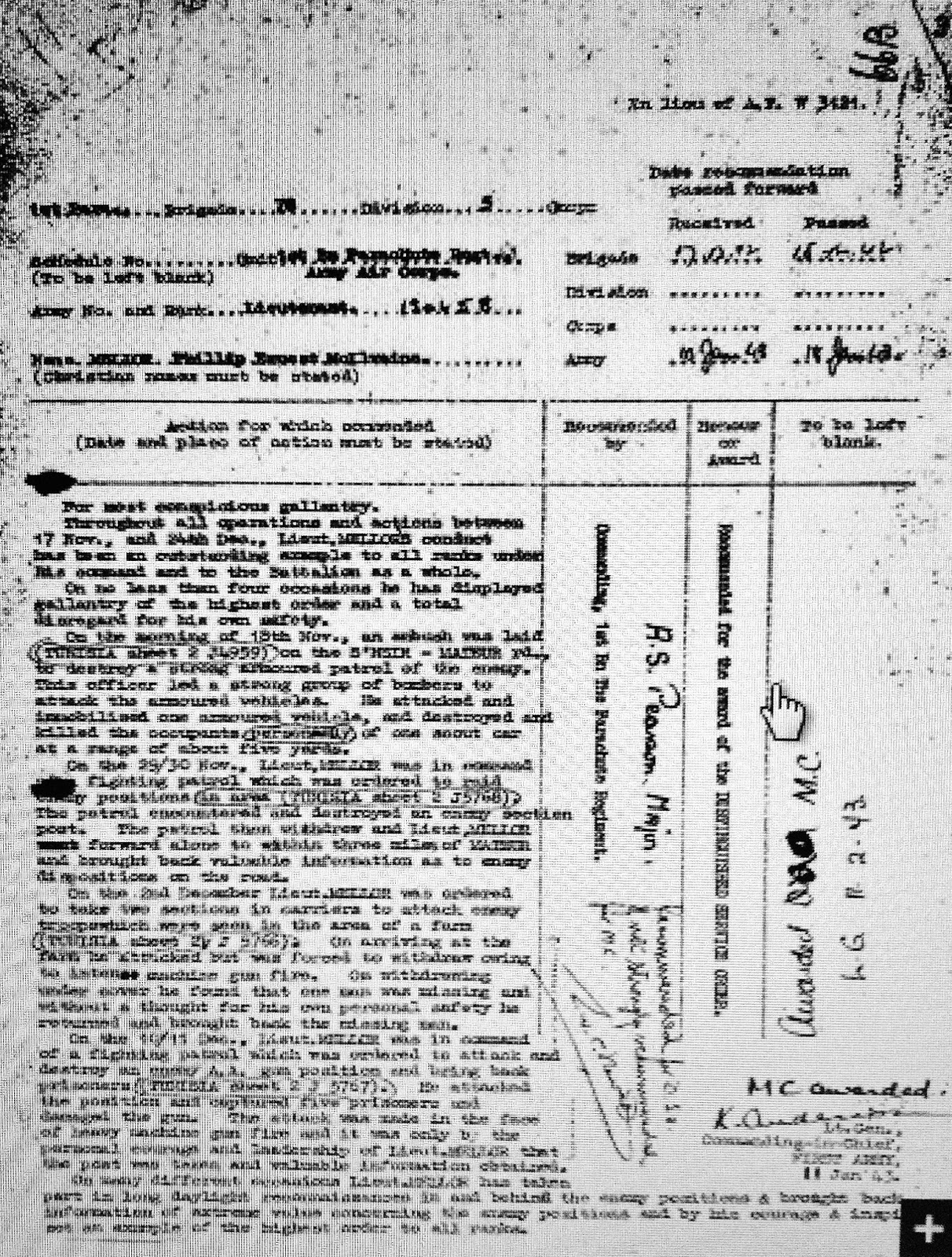
Read Lt Mellor's MC Citation HERE
at Paradata.org.uk

This is a lovely video by Paul Tasker detailing the Medjez-el Bab cemetery. 


Friday, May 27, 2016

WWIIPOD: No. 3 Commando Survivors of the Dieppe Raid Return to Newhaven, August 1942


Survivors of No. 3 Commando returning to Newhaven 
after Dieppe raid, 
August 1942.
~~Lt J H Spender (War Office official photographer) 
IWM # H 22588

Saturday, May 21, 2016

WWIIPOD: Lt Jack Butler 82nd CMB with Filipino Guerrilla Ricardo Gimotea, June 1945


Lt. Jack Butler of the 82nd Chemical Mortar Battalion with Filipino guerrilla Ricardo Gimotea sometime after Shimbu Line was broken around June 20, 1945. Ric and his cousin Jose had been fighting the Japanese for three years when they joined 2nd plt of the 82nd CMB. They were expert linesmen through difficult terrain, and described as "courageous and willing" warriors. 
- WWII Files
May 21, 2016, with research from Lt Col (Ret.) Jack Butler's memoirs and recollections