Saturday, January 12, 2019

Private Donald Reginald Schwartz, KIA 6.6.1944, 7th Light Infantry Parachute Battalion

Today we honor Private Donald Reginald Schwartz, 7th Light Infantry Para Battalion. Early 6 June 1944, the 7th LI Para Btn was so horribly misdropped in Normandy that 60% of the battalion were missing, with a few stragglers finding their way to their unit by the end of the day. Private D.R. Schwartz was one of these men whose body was never found. He was 20. It's one thing to lose a family member in combat, it's another to never have a grave to visit. Thank you for sharing your warrior with us J. Davey family.


Thursday, January 10, 2019

Pte Patrick Edwin Garraway, KIA 28 April 1945

The Forgotten Army Dogtag Project has led to some incredible stories and places. Sometimes they're the worst sort of places; the stories of the young warriors who didn't come home.

Today we honor the Uncle of a member who wrote in to see if we had her relative's dogtags. Unfortunately we don't at this time, but I was able to learn about her Uncle; Private Patrick Edwin GARRAWAY, killed just a few days before War's end on 28 April, 1945, age 22.
He served
with the Irish Regiment of Canada, R.C.I.C. He was killed during the fighting to reduce the Delfzijl Pocket in Holland. War ended May 8, but 21 young heroes of the Irish Regiment of Canada died during this particular action 10 days before the War's end. Private Patrick Edwin Garraway is buried in Holten Canadian War Cemetery in Holland. We remember and honor you.
Thank you for sharing him with us Ms. T. Langley.


THE FORGOTTEN ARMY DOGTAG PROJECT

I've been working as the lead researcher in an extensive project called The Forgotten Army Dogtag Project. My colleague, Dan Mackay, has dug over 31,000 military dogtags, and has done a brilliant job cleaning, cataloging researching, and archiving them. We are an unlikely duo, friends from "across the pond" who are obsessed with the men these tags represent and the hunt to discover their stories, faces, and the boys they knew who didn't come home. 

We love research and connecting it with the families of today, filling in the gaps of the stories that were never told. I spent time in King's College London in May 2017 finding the origins of the tags. They were made per General Lethbridge's recommendation after his time in Papua New Guinea studying Commonwealth Troop's army kit. He determined that the WW2 fibre dogtags/identity discs were not sufficient and should be updated to a metal tag prior to the invasion of mainland Japan (Operation Downfall). Preparations were well underway, and the new tags were manufactured per Gen Lethbridge's recommendation. 

As we all know, the invasion of mainland Japan never happened, and the tags sat at archived at a base outside London until the base finally closed, and everything trashed in a small landfill. Our tags are the surviving soldiers of the UK Armies of WW2, who served at some point in time in an Armoured unit. Post WW2, the new tag template was set and boys in National service and through the Korean War were issued these tags; to turn them back in during demobilization. I've been finding families now for 2 years and returning dogtags. 

It's an incredible project, but we'd love to get more home! We've uncovered stories of the soldiers behind these tags of epic proportions... some were captured at Dunkirk, and spent 5 years in POW camps; some transferred to the Paras and fought at Arnhem, some boys fought Rommel at El Alamein, many boys hit Sword and Gold Beaches on DDay and fought through to Germany; more than I can count were wounded, captured, earned Military Medals, and Mentioned in Despatches. We have almost every regiment in the Army represented, and every front the UK forces fought represented. Many times the families I speak with tell the stories of how their father was the only one left after certain tank battle engagements.  

These tags represent much more than the soldiers which bear their names; but also the boys who didn't make it home. We are looking for press help, people to share about the project, and people to reach out to see if we have their fathers/grandfather's tags. We're several years into the project, and I won't stop searching for families, but it would be even easier if people reached out to us!

Please message me directly if you're willing to assist with press coverage, wwiifiles@gmail.com.  The more people who know about our project the easier it will be to return tags! We filmed a very short video article with BBC One's show INSIDE OUT that aired in October 2017. The project has progressed greatly since then. I'm also interested in hearing from corporate sponsors. Email me for contact information. I'm attaching 3 photos; one a pile of just SOME of the tags, another a photo of a young recruit a family sent us after receiving his tag, and a full set of three found (and returned!) to the family. 

Monday, February 13, 2017

Private James L. Aaron, 'Battling Bastards of Bataan' POW who perished after the Bataan Death March, 31st Infantry Regiment, 7th Infantry Division

PRIVATE JAMES L. AARON, 14047086
Born:  April 7, 1923
Died:  July 16, 1942 (Report of Death)
Army Service Number according to NARA POW Archives: 14047086
James was born in Adair County, KY to parents James V and James V and Maggie May Platt Aaron.  He had several siblings, and by 1930 the family had settled in Knoxville, TN (address listed as on Kingston Pike), where James completed grammar school.
He enlisted in the US Army on February 13, 1941 at the age of 17 at Fort Mcpherson, Atlanta.  He listed his birth year as 1922 on his enlistment paperwork to show his age as 18 instead of 17 as he was born in 1923.  Incidentally, his enlistment records have him listed as an Actor for his occupation. 
He became a member of the 31st Infantry Regiment, 7th Infantry Division, and was sent to the Philippine Islands.  
According to "Short History of the 31st US Infantry Regiment - The Polar Bears
'America’s Foreign Legion'" this is the fate of the 31st Infantry Regiment in regards to the Japanese invasion of the Philippines and their subsequent torture and starvation during the Bataan Death March and captivity in POW Camps:  
"On 8 December 1941, Japanese planes attacked U.S. military installations in the Philippines. A 31st Infantry sergeant on detail at Camp John Hay became the campaign's first fatality. After landing in northern and southern Luzon, the Japanese pushed rapidly toward Manila, routing hastily formed Philippine Army units that had little training and few heavy weapons. The 31st Infantry covered the withdrawal of American and Philippine forces to the Bataan Peninsula. Unfortunately, the peninsula had not been provisioned with food and medicine and no help could come in from the outside after much of the Pacific fleet was destroyed at Pearl Harbor and mid-ocean bases at Guam and Wake Island were lost. Despite starvation, disease, no supplies, obsolete weapons, and often inoperative ammunition, the peninsula's defenders fought the Japanese to a standstill for 4 months, upsetting Japan's timetable for Asia's conquest. When MG King announced he would surrender the Bataan Defense Force on 9 April 1942, the 31st Infantry buried its colors and the cherished Shanghai Bowl to keep them out of enemy hands. Some of the 31st's survivors escaped to continue resisting, but most underwent brutal torture and humiliation on the Bataan Death March and nearly four years of captivity. Twenty-nine of the regiment's members earned the Distinguished Service Cross and one was recommended for the Medal of Honor, but the entire chain of command died in captivity before the medal recommendation could be formally submitted. Roughly half of the 1600 members of the 31st Infantry who surrendered at Bataan perished while prisoners of the Japanese."
The 31st Infantry Regiment "Short History" also says, 
"When the Japanese invaded the Philippines, the 31st was the main unit defending Manila. Since Manila was considered indefensible it was declared an open city and the 31st moved to the Bataan Peninsula to fight until help arrived. The “Battling Bastards of Bataan” held out against a vastly superior force with no reinforcement or resupply from December 13, 1941 to April 9, 1943, and only surrendered when ordered to by their superior officers.
The 31st went into captivity in the infamous Bataan Death March where thousands of American and Philippine soldiers were marched 68 miles in the blazing sun with no water. Thousands died or were killed by their captives. Many were already sick from lack of food and medicine during the siege. They were to spend the next 42 months in brutal captivity."

According to Private James L. Aaron's National Archives POW paperwork, the first report of his POW status was May 7, 1942, and his last status report/death was reported as of July 16, 1942.  After surviving the horrific Bataan Death March, he was held in Cabanatuan Prison, Luzon, Philippines, where he perished.  His body was not recovered, and he is memorialized on the tablets of the missing at the Manila American Cemetery and Memorial, Manila, Philippines.  
Today marks the 26th anniversary of the day hero James L. Aaron walked into an Army Enlistment Officer and signed his name on the line committing to give all for his country if that was the cost. Thanks to the South African War Graves Project, we have a snapshot of his name etched in stone.  I've edited it for clarity.


~~WWII Files
February 13, 2017

Friday, December 16, 2016

Scottish Brothers Donald and John McKay, Royal Engineers and Royal Scots Fusiliers; KIA in WWII

While doing research on another file, I stumbled upon two Scottish brothers, KIA in WWII.  Donald and John McKay were born in Glasgow, Scotland in 1914 and 1917 respectively, (although Army records show John's year of birth as 1921).  There were 8 siblings in all, and tragedy struck the family early when an infant brother died of measles. 


Lieutenant Donald Bell McKay served with the 270th Field Company, Royal Engineers, attached to the 46th Infantry Division.  He was fighting the Tunisian Campaign when he fell March 23, 1943, age 28.  He is buried at Tabarka Ras Rajel Cemetery.  

At Left, a studio portrait of Donald Bell McKay, courtesy of the McKay/Alderding family.  


Above, Donald McKay (second from right) poses with his Army bandmates.


Left:  Donald McKay (at left) 
Right:  John McKay 
Both photos courtesy of the McKay/Alderding family

Donald's younger brother, John, was born in 1917.  We do not know when he learned of his brother's death (that occurred 21 months before his own). He fought with 4/5th Battalion, Royal Scots Fusiliers.  September/October 1944 the 4/5th Battalion was attached to the 52nd Lowland Infantry Division.  They took part in the daunting, vital, and complicated 5-week Battle of Scheldt.  The 52nd (Lowland) Infantry Division earned high praise in it's part of the success with opening the port of Antwerp enabling Allied use for supply lines through NW Europe.  After 5 weeks of battle, the 52nd stayed at Walcheren Island through November 1944.  On December 5, the 52nd was was transferred to the British XXX Corps.  By the time of John McKay's death, the 4/5th Battalion of the Royal Scots Fusiliers was around the River Meuse.  Securing bridges over the River Meuse was what his unit was tasked with during the Battle of the Bulge; with John McKay and buddy, Jack Blackburn, both in the 4/5th Royal Scots Fusiliers, falling in battle December 16, 1944.  He is buried not far from where he fell near the Meuse, at Brunssum Cemetery in the Netherlands.

When brothers fall in War, our minds undoubtedly turn to the grief of their dear fathers and mothers.  However, on April 29, 1935 (her 22nd wedding anniversary), Mary Flora McKay, age 49, died of a stroke.  Her husband Neil, age 55, died 4 years later on September 12, 1939.  The parents of Don and John were spared the grief of their son's deaths, but not so the 5 surviving siblings of the McKay family, having lost so many family members in a short period of time.

Today is the 72nd Anniversary of John McKay's death.  We remember him, his older brother Donald, and their families they left behind.  This humble family from Glasglow sacrified much and we remember and honor your loved ones.


L:  Donald McKay's first grave, 1943, in Tunisia

R:  John McKay's grave, 2016, at Brunssum Cemetery, Netherlands


Donald's grave photo courtesy of the McKay/Alderding family
John's grave photo courtesy of Ruud Scholten, Chairman of the Foundation War Cemetery at Brunssum

My heartfelt gratitude is extended to Lily Alderding of AU for her generous assistance in memorializing her cousins, and to Ruud Scholten of the War Cemetery in Brunssum for his quick assistance and for his diligence and deep dedication to honoring the young men resting in Brunssum.


~WWII FILES, December 16, 2016


Wednesday, November 30, 2016

Losses of HQ and HQ Co, 67th Armored Regiment, 2nd Armored Division- July 29, 1944

Recently, I was gifted with a copy of History of the 67th Armored Regiment of the famous 'Hell on Wheels' 2nd Armored Division. It was owned by a friend's father, Gilbert White, who fought with the 67th in HQ and HQ Company.  It was published in Brunswick, Germany in 1945, just after the War ended.  The inscription on the front was where Gilbert White signed his name and hometown, claiming his personal copy.  This is a 407 page volume detailing the regiment from North Africa to The Elbe in Germany, with each battalion, HQ, Reconnaissance, Maintenance, and Service Companies getting their individual histories recorded.  There are also dozens of pages photographs, the entire regiment's roster (November 1942- May 1945) with decoration and KIA notations, and large, full-colour, fold out maps in the back of the book.  To say the book is a treasure is an understatement.  
Despite  Headquarters and Headquarters Company being with the regiment from it's first action in North Africa, November 1942, they did not have any casualties until 20 months later. Oddly, this company, while belonging to arguably our nation's fiercest armored division in WWII, did not lose a man at the rate other's were lost in the regiment in North Africa, Italy, or the Normandy campaign.   
HQ and HQ Co sailed for Normandy the night of June 10, 1944.  June 16th (1944) "the company experienced their first enemy artillery fire.  There were no casualties although several shells landed in the area perforating C.W.O. Hobbs tent and a piece of shrapnel piercing Pvt. Mc.Coys helmet that was lying next to him.  The next morning slit trenches were on an average of two feet deeper." (p.317). 
"...On the 21st of July all officers were carefully briefed on the coming operation.  The large plan involved the smashing of the enemy crust in a concentrated bombing attach, after which the 9th and 30th Infantry Divisions were to roll back the flanks and the Second and Third Armored DIvision and 1st Infantry Divisions poured through the center." (p.319) This was the battle plan for Operation Cobra to begin July 25, 1944.
The history takes up a couple of days into Operation Cobra, 
"The next afternoon (27 July) the company was again on the move, passing through the devastated country side that had been the scene of the bombing attack.  Not a living thing was to be found along the way.  Dead horses and cattle lay everywhere along with wrecked German vehicles and dead Germans.  A little further on the burnt out hulls of American tanks were seen and occasionally a dead American Infantryman. ... At daylight the next morning they were just outside of Notre Dame de Cenilly.  Small arms fire could be heard up ahead and the company pulled off the road until about 1100 then proceeded on through Notre Dame and halted again just south of town, still on the road.  The Krauts began shelling the town so the Company moved a few hundred yards down the road.  Shortly after that Captain Sanborn arrived at the scene with orders to move back and clear the road.  The Company turned around and moved to an orchard just east of town." (p. 319). 
The next bit of action is stunning and and unexpected.
"The next morning the company moved about three miles further south and pulled off the road.  Nearly all the vehicles were in the bivouac when the Medical Detachment half-track pulled over the swing into the field.  It ran over a pile of sixteen anti-tank mines left there the night before by part of the 4th Infantry.  A terrific explosion occurred, instantly killing Major Montfort Smith, Technician fifth grade McKay, a motorcycle rider from Second Battalion, two men from the 4th Infantry Division and two civilians.  Captain Sanborn was critically injured and died on the way to the hospital.  Captain Raffington, Technical Sergeant Wallace, Technician fourth grade Roberts, Technician fifth grade Dimock, Private Wiggins, Sergeant Hafner, and Technician fifth grade Cordell of the Medical Detachment and Private 1st class Garret and Private 1st class Willinghan of the company were seriously injured.  These were the first casualties suffered by Headquarters and Headquarters Company and their loss was keenly felt by their many friends and buddies in the Company." (p. 320). 

What a bitter pill to swallow.

UPDATE AUGUST 2018: 
In August 2018, I led a Western European tour in the footsteps of the 22nd Infantry Regiment, 4th Infantry Division.  While in Normandy, we spent part of an afternoon at the American Memorial Cemetery in Colleville-Sur-Mer, Normandy.  Because I had spent the year working on the finer points of my tour and history of the 22ndIR, I was not looking for particular soldiers of other regiments buried in Normandy.  While walking among the thousands of graves, however, the location of where Cpt Oliver True Sanborn was resting stopped me dead in my tracks.  Covered in goosebumps, the photos of him I've seen, and his story washed over me.  Two years before I had written this article about him.  It was a full circle moment to accidentally walk right upon him. In the many years I've working on research projects, the ways that certain stories come to me in serendipitous and providential ways have been nothing short of incredible.  It has been true to my experience that even many decades after the events, certain men and stories are crying out to be discovered, heard, and known.   


Oliver True Sanborn, Jr.- his senior portrait and quote at Portland High School, ME
He was the Captain of  his high school army cadets
He is buried at 
Plot E Row 28 Grave 26,
Normandy American Cemetery
Bronze Star, Purple Heart


Captain Oliver True Sanborn Jr. is buried in the Collville Sur Mer cemetery in Normandy, as is Tec5 John W. MacKay (spelled wrong in the regtl history).  Major Montfort Smith is buried in Arlington National Cemetery.  SEE UPDATE ABOVE ON THE STORY OF THIS GRAVE PHOTO. (Aug. 2018)


Tec 5 John W. MacKay's body internment paperwork
Plot E Row 17 Grave 26,
Normandy American Cemetery
Purple Heart


Montfort Smith, 1934, a Junior
at the University of Illinois
Major Smith is buried at
Arlington Natl Cemetery,
Section 12, Grave 5228


~~NOVEMBER 30, 2016
WWIIFILES

Thursday, October 6, 2016

Happy Birthday PFC REGIS GALLAGHER; 672nd Amphibian Tractor Battalion- October 6, 1923- June 21, 2008

I am happy to have happened upon an extensive photo album and WWII diary of PFC Regis Gallagher. I am proud to have a photo record of a little known unit, the 672nd Amphibian Tractor Battalion. He spent time on Bougainville attached to the 37th Infantry Division, preparing for the invasion of Luzon, Philippines.  He hit the beach January 9, 1945 with the 37th Infantry Division and fought all the way to Manila.  On February 23, 1945 his unit made the amphibious attack on the Los Banos internment camp.  Afterwards, his unit was shipped to Morati where they trained with the Australian 7th Army.  They sailed to Borneo and hit the beach July 1, 1945, where they fought for two weeks with the Australians in the last major Allied campaign in the Pacific. 
More of his diary will be published and more men in his unit shared, but until then; here are a couple photos of PFC Gallagher, remembering him 93 years after his birth.
Regis Gallagher; October 6, 1923- June 21, 2008
~~WWIIFILES
October 6, 2016

"ME- (Combat outfit), Luzon, Philippines March 1945"

"MY ALLIGATOR"

Tuesday, August 23, 2016

WWIIPOD: Waffen SS at Rest in Soviet Countryside; 1941


SS soldiers resting at a fence in the Soviet countryside. The soldier in the foreground on the left is armed with MP-38.

Monday, August 8, 2016

1st Battalion, 2nd Independent Parachute Brigade drop on Megara, Greece, October 12/13, 1944- Operation Manna

1st Battalion, 2nd Independent Parachute Brigade dropped on Megara, Greece, October 12/13 1944


     This was part of Operation Manna (mid October 1944 to mid January 1945), from October 12/13 when one company of 4th Para Bn was dropped onto the Megara Airfield at the operation's onset. 
British units (5th and 6th Para Bn, and parts of the 2nd and 4th Para Regiments) were tasked with multi-faceted missions in Greece, "harrassing the anticipated German withdrawal from the Balkans", street fighting while keeping political order as Civil War developed in Athens, while providing basic food and supplies to the tens of thousands of civilians living among the chaos. 
     "5th Para Bn suffered over 100 casualties and 6th Para Bn lost all it's company commanders in fighting widely misunderstood by press and public opinion back home. The task was successfully completed by January 1945. The irony of the deployment was encapsulated by the final day's fighting in Athens when the Brigade had killed 170 rebels, wounded 70 and captured 520 while concurrently feeding 20,000 civilians each day."
(Quotes from ParaData.Org.UK)

Thursday, July 21, 2016

Legendary Major General John Frost "THIS IS YOUR LIFE" episode; 20 years post WWII


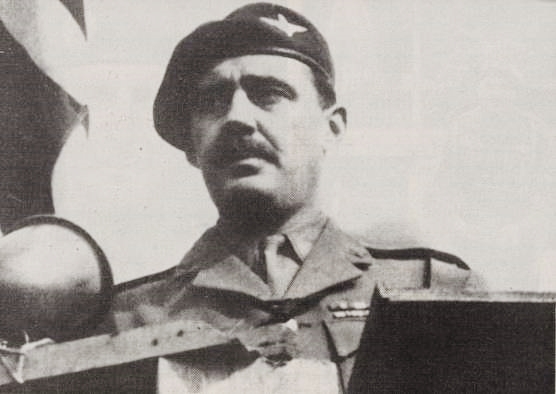
LTC John Frost speaking to the people of Arnhem in 1945 at the unveiling of a monument to commemorate the bridge action. Copyright: Imperial War Museum.
     This is one of the coolest interviews/television shows I've ever seen: 
"This Is Your Life; Major General John Frost"
It covered his military career and campaigns from Feb '42, Operation Biting in Bruneval, France, North Africa/Tunisian campaign, Sicily and the Italian campaign, to his capture at Arnhem September '44. If you've studied the 1st Para Brigade you'll hear many familiar names- I loved seeing Major General Frost reunited with men from every time and place he fought during the War; even his German counterpart! The audio is out of sync in Part 2, but still well worth the watch: