Wednesday, May 22, 2019

PCF Yandell Guinn Cambron, Post-humous Silver Star; KIA 10 August 1945 Mt. Puloy, Luzon, Philippines- E Co. 20th IR, 6th ID

PCF Yandell Guinn Cambron was born in Meadow, Terry, Texas on 25 June, 1925.  He was just 4 years old when his mother, Edna Cambron passed away on 13 October, 1929 from an acute obstruction due to a femoral hernia.  He was then raised with his father and 7 older siblings (4 sisters and 3 brothers).  By 1940 he and his family were living in Sulphur Springs, Texas where he attended Sulphur Springs High School.  He is pictured at age 16 in 1941 from the Sulphur Springs High School Yearbook. 

 Yandell was working in for a U.S. government post in an engineers majors field in Greenville, Texas when he registered for the draft on his 18th birthday, 25 June, 1943.  A little over a year later he enlisted into the US Army; September 5, 1944.  He was sent as a replacement to the 20th Infantry Regiment, 6th Infantry Division in the Pacific.  He fought with the 20thIR, 6thID on the Luzon Campaign in the Philippines.  It was hot season when he arrived; the heat was stifling; the bugs relentless, the sun scorching his light-skinned face.  Drinking water was always warm, marches through the mountains and trails they fought were enough to make a pack mule lay down and refuse to budge.  The roads were little more than widened trails, winding through valleys and hills.  The rains were torrential and they slogged through rivers and sucking mud.  But above all the Japanese were dug in at every twist or turn in the trails, jungles and mountains; fighting to the death; taking as many American boys and Filipino fighters with them.
According to the 6th Infantry Division history "Luzon Final Phase"  PFC Cambron's death occurred during the assaults of Mt. Puloy in Ifugao territory.  I've combed through the maps and files of this assault, and have noticed a mistake.  The reports reference locations in vicinity of Antipolo, but Antipolo was several hours away.  It is my opinion that the location of Mt. Puloy (not noted on current maps) near "Antipolo"  is actually the ridgeline and mountain directly Northeast of ASIPULO.  While the 6th Infantry did indeed fight in and around Antipolo February-April 1945 to work to break the Shimbu Line, they were no where near Antipolo in July/August 1945.  However, the mountain and ridge described in the reports and on 6thID maps would be the unmarked mountain and ridge northeast of Asipulo, and directly northwest of Kaigan, southwest of Lagawe; with the Hungduan valley to it's west.  You can see the bowl-shaped valley on the east side of the Mt. Puloy ridgeline that is still today the ancient and beautiful rice terraces of Ifugao territory.

LUZON FINAL PHASE STATES:
From 7-10 August, Company "B", 20th Infantry, tried to find a way to knock out the resistance atop MT. PULOY without success.  The enemy covered the trail from commanding positions which could not be outflanked.  It was now apparent that a frontal assault to take the crest would be extremely costly.  
During the same period, Company "C" probed along the trail leading southwest from PACDAN, encountering slight resistance, until relieved by elements of the 2nd Battalion, 20th Infantry, on 9 August. 
In the meantime, Company "A", 20th Infantry, attacking north from PACDAN on 7 August, finally gained the top of a narrow, knife-edge ridge to the southwest of Mt. Puloy on 9 August.  Attempts to attack to the NW from this position were stopped by heavy fire and adverse terrain precluded any maneuver by friendly troops.
The enemy, during the period, was aggressive and made several small night counterattacks.
At this time, Ifugao scouts reported the existence of a new trail, leading over the southwestern part of Mt Puloy, which had been developed by natives in the area to avoid Jap units disposed along the main trail.
The 20th Infantry, therefore, ordered the 2nd Battalion to reconnoiter this route with the view of attacking in this direction and by-passing the main Jap positions, while the 1st Battalion contained the enemy to their front.
On 10 August, Companies "E" and "F", 20th Infantry, consolidated positions gained about 1,200 yards west of PACDAN against scattered opposition."

It was here that PCF Yandell Cambron was killed while "leading the way up a steep hill, killing four snipers before losing his life at near the crest."  He posthumously earned a silver star for his actions of valor. He was barely 20 years old.
The fighting continued for another 5 days on and around the extensive 2 mile ridgeline of Mt. Puloy before the War was declared over on 15 August, 1945. 


A sector of SE Mt. Puloy, showing part of the ridgeline, rice terraces, and the formidable jungle/mountain terrain

PCF Yandell Cambron's body internment paperwork 19 August, 1949
PCF Yandell Guinn Cambron was reburied in the West Hill Cemetery of Sherman, Texas.  


Pvt Abraham Kalmikoff, Silver Star, Purple Heart, KIA 11 July 1944, F Co, 38th Infantry Regiment, 2nd Infantry Division

WW2 2nd ID patch
I discovered the story about Pvt Abraham Kalmikoff (of the 2nd Infantry Division) in a most unusual way.  
I get requests from colleagues all over the world to find WW2 combat veterans whose war artifacts have been found or acquired by military enthusiasts, metal detectorists, historians, collectors, or a civilian coming upon it by chance.  This request was no different.  However, the dogtag in this story, and how it was discovered was unique. 
Mr. Bradley is a friend in the UK, and we've worked on a few WW2 files regarding US Army dogtags and artifacts found on battlefields in Europe. 
Scott Bradley of WW2
Treasure Hunters
Mr. Bradley's father had rescued the tag in question from a pile of junk about to be sent to recycling.  It was pure happenstance he was there that day and took a moment to flick through the bits and bobs of metal about to be sorted and smelted at a recycling centre.  He gave the tag to his son, and due to it's deteriorated state it's story was not pursued further for a few years. 
Spring 2019 Mr. Bradley reached out to me to see if I could divine who the tag once belonged to and perhaps was there a veteran still alive or a family who might want it?

The photo of the tag as it was sent to me early 2019

Without a doubt, this was my most difficult case yet... not in terms of tracking the family, but in terms of simply reading the tag.  I spent several hours playing name games and working through combinations of letters and locations to cross-reference which surname the tag belonged to.  Finally the search bore fruit and I hit upon the KALMIKOFF family.  
Abraham Kalmikoff was born to Russian-Jewish immigrants in Brooklyn, NY September 10, 1920.  He enlisted in the US Army February 1941 (listing he was born in 1919 instead of 1920) after working as a shipping/receiving clerk and completing 3 years of high school.  He married Mary Rabichev and they had one child, Barbara Kalmikoff, born December 1943. 

Someone erroneously wrote on the photo that Pvt Kalmikoff was KIA during the Battle of the Bulge
(photo preserved and kept in the family archive of Abie's cousin Anne Kalmikoff Miller)

Soon Pvt Abraham Kalmikoff was overseas with F Company, 38th Infantry Regiment, 2nd Infantry Division.  They crossed the English Channel onto Omaha Beach on June 7, 1944 (D-Day +1) near near Saint-Laurent-sur-Mer.  (This brief overview of their combat record belies the cost the 2nd Infantry Division endured during combat from 12-16 June as they tried to take Hill 192.  1,200 casualties over a few days grounded the division into defensive positions around Hill 192, sometimes sharing the same hedgerow with their German counterparts. It was not until a month later when the final assault for Hill 192 commenced.)  

"Attacking across the Aure River on 10 June, the division liberated Trévières and proceeded to assault and secure Hill 192, a key enemy strong point on the road to Saint-Lô. After three weeks of fortifying the position and by order of Commanding General Walter M. Robertson, the order was given to take Hill 192. On 11 July under the command of Col.Ralph Wise Zwicker the 38th Infantry Regiment and with the 9th and the 23rd by his side the battle began at 5:45am. Using an artillery concept from World War I (rolling barrage) and with the support of 25,000 rounds of HE/WP that were fired by 8 artillery battalions, the hill was taken."

Pvt Abraham's silver star citation states that: 

"Pvt Kalmikoff was a runner for the weapons platoon of Company 'F', 38th Infantry, during an attack in the vicinity of St. Jean-des-Baisants, France.  The supporting tanks were unable to cross the road until a suitable site was found which would be clear of mines for passage into the fields beyond.  
Private Kalmikoff, without hesitation, voluntarily went forward of our lines, braving the enemy artillery and small arms fire.  With disregard for his personal safety, he selected a route of advance for the tanks and directed fire on the enemy strongpoints before being killed.  Private Kalmikoff's actions aided materially in reducing the enemy strong points and in allowing the company to advance."

Pvt Kalmikoff's Silver Star Citation courtesy of Scott Kalmikoff


Referring again to the "St. Lo" report from the 'American Forces in Action Series, Historical Division, War Department the following actions of 11 July, 1944 are described: 

"Because the 38th Infantry line was curved back on the right, Company E on that wing began its attack at H-30 minutes in an attempt to straighten the regimental line. The uneven line resulted from a bloodless advance made on 1 July by the 3d Battalion, 38th Infantry, which pulled a "sneak play." Observing that the Germans on this front were withdrawing from their outpost line (OPL) to the MLR at night, to avoid ambushes by our patrols, the 3d Battalion took advantage of this procedure by a night advance. The move netted 800 yards, without fighting, on the left (east) but only 400 yards toward the division boundary. The enemy made no attempt to retake the OPL. At 0630 the 38th Infantry launched its main assault toward Hill 192, the 2d Battalion on the right and the 1st Battalion on the left, following 100 yards behind a rolling barrage. The regiment was reinforced by two companies of the 741st Tank Battalion, a company of the 2d Engineer Combat Battalion and a company of the 81st Chemical Mortar Battalion.

Company E on the right ran into stiff opposition almost immediately, as it tried to reach the small ridge commanding a draw leading up to the hamlet of Cloville. Here was one of the enemy strongpoints, already known as "Kraut Corner," fanatically defended by half a company of Germans who had survived the heavy artillery pounding prior to the attack. The 2d Platoon of Company E tried to work its way up to the first hedgerow in the fields, but was unable to advance because of automatic weapons and mortar fire. The enemy's mortars were registered on the hedgerow lines and blanketed all routes of advance. The 3d Platoon was sent in to give support; a few men succeeded in working their way near enough to the enemy position to throw hand grenades, but got no farther. The defenses of Kraut Corner finally gave way when the 1st Platoon got around the east side of the strongpoint. Scouts streaked along the flanking hedges, supported by BAR's, machine guns of the infantry, light mortars, and the two machine guns on a tank. When eight or ten riflemen penetrated the enemy defense, resistance crumbled, and 15 prisoners were taken. Three paratroopers who still held out were eliminated by a tank dozer which buried them under five feet of dirt.

Company E took more than an hour to clear Kraut Corner. To the left, Company F was moving more rapidly against lighter opposition. By the time Company E had passed the strongpoint, Company F had crossed the Cloville-St-Georges-d'Elle road, hitting and turning the weak flank of the enemy. Less than three hours after the jump-off, the left platoon of Company F entered a small wood near the west nose of the hilltop. Company E at this point was a quarter mile behind, trying to enter Cloville. The advance of the 2d Battalion had settled into a frontal field-by-field battle, accompanied by some house fighting in Cloville and le Soulaire. The enemy positions in Cloville had been shelled heavily by American artillery and both villages were badly damaged. Roofs had been blown off, walls shattered, and the streets were blocked by rubble. The enemy infantry, supported by automatic weapons, a Mark III self-propelled 88-mm, and a Mark IV tank, used the cover of the rubble in an attempt to hold Company E in Cloville. An American tank, after a brief fight, knocked out both the Mark III and the Mark IV, paving the way for infantry to move in and mop up the village. An hour and a half was still required before Company E completed this task and could move into the fields south of Cloville.

With Cloville taken, the 2d Battalion pushed its advance along the west slope of Hill 192, bypassing the village of le Soulaire, Company E going to the west and Company F to the east. At approximately 1700 the assault units reached the St-Lo-Bayeux highway and the infantrymen began to cross the road one at a time. The tanks were held up because of rough, wooded terrain and the fire of antitank guns and bazookas which covered both the highway and the roads running south from it. They finally slipped across on the left of Company F.

By the end of 11 July the 2d Battalion had organized and was defending the ground along the St-Lo-Bayeux road. It was the only assault battalion of the 2d Division to reach its objective that day, having advanced approximately 900 yards on an 800-yard front. The work had been done by two companies; Company G, which had not recovered from its losses of 16 June, remained in reserve during the day, suffering 17 casualties from enemy artillery fire."


It is my opinion that Pvt Abraham Kalmikoff was killed during the tedious crossing of the St. Lo- Bayeux highway.  The tanks were held up, and finally crossed to the left of Company F.  While infantrymen were slipping across the road one at a time, braving being an easy target during the sprint of their life; Pvt Kalmikoff was running back and forth, exposing himself, and working to find a suitable spot for the tanks to cross successfully.  It was here, in the harsh and bright sunlight of a waning summer's day in Normandy, about 5-6pm that he was killed.  

Pvt Abraham ("Abie") was mourned and deeply missed by his family; and the daughter who never had the opportunity to know him.  One interesting aspect of his military career stands out.  He enlisted in February 1941 and by July 1944 he was still a Private.  While none of the people who knew him are still living, I believe Abie was larger than life, a rebel, driving his commanding officers a little crazy, having no patience for 'ridiculous army rules', but was one helluva soldier and friend....and his brothers in arms loved him for it.  

Scott Kalmikoff introduced me to one of the last people who saw Pvt Abraham Kalmikoff alive.  I had the pleasure of speaking with Derek Burke on the phone about his time with Abraham Kalmikoff.  Just before the Normandy invasion Pvt Kalmikoff and one of his buddies traveled to Harpenden, Hertfordshire to visit the British side of his mother's family that he had not met before.   His mother and father's families had emigrated to the UK and USA from Belarus.  His mother's sister's family had moved from London to the countryside where they were safe from the death and destruction London and surrounding areas were enduring at the hands of Hitler's brutal bombs.  Pvt Kalmikoff stayed several days with his Aunts, Uncles and cousins.  Derek Burke was a very young child at the time, but still has a few warm and loving memories of Abraham Kalmikoff.  He remembers Abraham playing with him and tossing him into the hay piles.  Abraham also taught Derek two songs from America, the bluegrass classic "Deep in the Heart of Texas" and Bing Crosby's "Don't Fence Me In".  The news of Pvt Kalmikoff's death was something that shattered the hearts of the families, both in the UK and US.  Mr. Burke recalled the visit of Rebecca "Riva Leyka", Abraham's mother in 1952.  She was able to travel to visit her son's grave in Normandy.  Later in life when Derek visited Abraham's grave, his elderly Aunts sent their blessings and grief.  Derek also recounted much more sorrow the extended Kalmikoff family shouldered during the War.  A large Jewish family, originally from Shklov, Belarus, many of their relatives and friends still in Shklov were brutally executed by the German killing squads (including Sondercommando 7b) starting in the summer of 1941.  Pvt Abraham Kalmikoff's fight was personal and deep.  His loss is ever poignant against the backdrop of the darkness of fate his extended family suffered.  

Pvt Kalmikoff was eventually buried in the Normandy American Cemetery and Memorial at Colleville-Sur-Mer,  Plot I Row 17 Grave 29.
Pvt Abraham Kalmikoff's Grave in Colleville-Sur-Mer; 
courtesy of the Kalmikoff family


The mystery of how the dogtag came to be in England may never be solved.  The tag was sent to a recycling centre during a house-clearing process after it's unknown resident died.  The Bradley father and son were quick to retrieve and protect this fragile tag for several years.  Pvt Kalmikoff's tag is now in route to be united with his beloved daughter, Barbara.  This reunion would not be possible without the expert assistance of the Kalmikoff family historian, Rabbi Scott Kalmikoff of New York. 

Barbara and her mother Mary, Abraham's daughter and widow


Rabbi Scott Kalmikoff, family historian

When there is a death due to combat, a deep soul hole of missing and grief is formed in a family; even unto several generations.  The agony of loss of the young men who have fallen in wartime is beyond the scope of language to describe.  Mr. Bradley of the UK, Rabbi Scott Kalmikoff of New York, and myself are so thankful to have met one another in this full-circle way; 78 years after Pvt Abraham Kalmikoff enlisted in the US Army. His dogtag bears the effects of violence, and I'm utterly grateful it was not deteriorated more when I began to examine it via the photograph above.  

We salute you Pvt Kalmikoff, and honor your memory.  

Pvt Abraham Kalmikoff's spirit was bright, joyful, free, determined, courageous and loyal unto death.  Poetically, the refrain from Bing Crosby's "Don't Fence Me In" is a fitting sentiment to close the telling of his story and to remember his spirit and sacrifice: 

"Oh, give me land, lots of land under starry skies
Don't fence me in
Let me ride through the wide open country that I love
Don't fence me in
Let me be by myself in the evenin' breeze
And listen to the murmur of the cottonwood trees
Send me off forever but I ask you please
Don't fence me in"

Thursday, May 16, 2019

UNKNOWN African-American WW2 Naval Chief Petty Officer and beautiful woman Margie

I'm publishing these photos in as large a format as they will scan.  I found them together in an envelope at an antiques mall in Knoxville, TN.  "Margie" is the beautiful woman's name in the 3 photos below.  The Chief Petty Officer's name is unknown.  The back of one of Margie portraits is dated 1944.  However, based on the sailor’s ribbon bars, I believe his photo was taken post-WW2.  I'm going with chief petty officer based off his cap. 

I'm working to make out which ribbon bars he is wearing on his suit and what city he is in.  
So far I'm thinking top to botton, L to R:
1) Navy and Marine ribbon
2)American Defense 
3) Philippine Liberation Medal
4) ????
5) Asia-Pacific w/ 3 campaign stars
6) American Theater Campaign
7) Navy good Conduct

The stories of our African-American WW2 heroes are largely not understood or known. I'm working on a series of African-American soldiers from the deep South who enlisted and fought in the War.  
Please contact me directly if you know these people, recognize the city or house, or if you can offer a correction to my working identification of his ribbon bars or rank—wwiifiles@gmail.com


Thursday, May 9, 2019

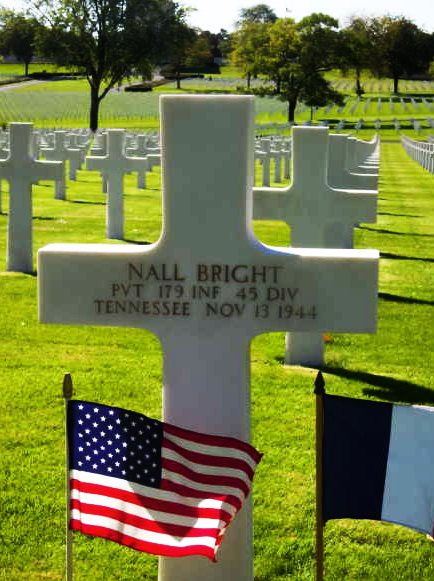
PVT NALL BRIGHT, 179th Infantry Regiment, 45th Infantry Division; Died in captivity as a POW 13 November, 1944


 Pvt Nall Bright, born 4 October, 1906 to Mr. and Mrs. John and Elizabeth Bright of Chattanooga, TN.  He had 1 younger brother, John Bright, 1908-1995.
Nall Bright was married to Mrs. Mina Bright, and by 1940 they lived in Chattanooga, TN, where Nall worked as a bookkeeper.  They had no children.  Nall's younger brother, John (born 25 September 1908) was an ordained Presbyterian minister and served in the US Army as a Chaplain from 1943-1946.
Nall Bright 1925

He enlisted in the army on 19 July, 1943 in Hamilton County, TN.  He completed basic training at Camp Wheeler, Georgia.  He was transported to Italy in the Spring of 1944 where he fought with the 179th Infantry Regiment, 45th Infantry Division in Italy (after the invasion of Anzio) until they were taken off the line to prepare for Operation Dragoon.  The division’s reserve regiment, the 179th Inf. Regt., landed across Delta Green Beach (near Cape Sardineaux), assembled in the beach area and entered into combat on D+1, 16 August 1944.

He was captured on 31 August/ 1 September during a surprise counter-attack by the elements of the 15th and 209th Panzer Regiments, 111th Panzer Grenadier Regiment of von Wietersheim's 11th Panzer Division while defending Meximieux, France. He was 1 of 185 179th Regiment troops who were listed as missing after the heated and furious battle of Meximieux.  

Pvt Nall Bright was transported across France into Germany and was initially a resident of Stalag 12A/XIIA- a notoriously awful prison camp used to register prisoners in transit.  It had little in the way of facilities, and rations were a little above starving portions.  He was then transferred to Stalag 9B.  Inmates at Stalag 9B were from at least 8 countries, Russia, Italy, Great Britain, Belgium, Serbia, Slovakia and the US.  An unknown number of inmates perished there during the War. Pvt Bright's record states that he was reported as deceased on 13 November, 1944.  He died of complications from pneumonia. 
Pvt Nall Bright is buried at Lorraine American Cemetery and Memorial just outside Saint-Avold, Moselle, France; Plot J Row 46 Grave 25.


The first photo supplied is from when Mr. Nall Bright was a student at Presbyterian College in Clinton, South Carolina in 1925, aged 19. Photo 2 is his senior portrait from Presbyterian College, 1927, stating his many attributes and leadership qualities.  The next photo is a news article via the Pi Kappa Phi society August 1945, (erroneously stating the date which he landed in Southern France). 

We salute you, Pvt Nall Bright.  You were a son, brother, husband, and comrade in arms.  I close with the quote Nall Bright chose for his senior page at college, excerpted from the poem 'Some Future Day When What Is Now Is Not by John Hugh Clough:
"Shall we indeed, ye winds and waters, say!
    Meet yet again, upon some future day?"


Saturday, January 12, 2019

Private Donald Reginald Schwartz, KIA 6.6.1944, 7th Light Infantry Parachute Battalion

Today we honor Private Donald Reginald Schwartz, 7th Light Infantry Para Battalion. Early 6 June 1944, the 7th LI Para Btn was so horribly misdropped in Normandy that 60% of the battalion were missing, with a few stragglers finding their way to their unit by the end of the day. Private D.R. Schwartz was one of these men whose body was never found. He was 20. It's one thing to lose a family member in combat, it's another to never have a grave to visit. Thank you for sharing your warrior with us J. Davey family.


Thursday, January 10, 2019

Pte Patrick Edwin Garraway, KIA 28 April 1945

The Forgotten Army Dogtag Project has led to some incredible stories and places. Sometimes they're the worst sort of places; the stories of the young warriors who didn't come home.

Today we honor the Uncle of a member who wrote in to see if we had her relative's dogtags. Unfortunately we don't at this time, but I was able to learn about her Uncle; Private Patrick Edwin GARRAWAY, killed just a few days before War's end on 28 April, 1945, age 22.
He served
with the Irish Regiment of Canada, R.C.I.C. He was killed during the fighting to reduce the Delfzijl Pocket in Holland. War ended May 8, but 21 young heroes of the Irish Regiment of Canada died during this particular action 10 days before the War's end. Private Patrick Edwin Garraway is buried in Holten Canadian War Cemetery in Holland. We remember and honor you.
Thank you for sharing him with us Ms. T. Langley.


THE FORGOTTEN ARMY DOGTAG PROJECT

I've been working as the lead researcher in an extensive project called The Forgotten Army Dogtag Project. My colleague, Dan Mackay, has dug over 31,000 military dogtags, and has done a brilliant job cleaning, cataloging researching, and archiving them. We are an unlikely duo, friends from "across the pond" who are obsessed with the men these tags represent and the hunt to discover their stories, faces, and the boys they knew who didn't come home. 

We love research and connecting it with the families of today, filling in the gaps of the stories that were never told. I spent time in King's College London in May 2017 finding the origins of the tags. They were made per General Lethbridge's recommendation after his time in Papua New Guinea studying Commonwealth Troop's army kit. He determined that the WW2 fibre dogtags/identity discs were not sufficient and should be updated to a metal tag prior to the invasion of mainland Japan (Operation Downfall). Preparations were well underway, and the new tags were manufactured per Gen Lethbridge's recommendation. 

As we all know, the invasion of mainland Japan never happened, and the tags sat at archived at a base outside London until the base finally closed, and everything trashed in a small landfill. Our tags are the surviving soldiers of the UK Armies of WW2, who served at some point in time in an Armoured unit. Post WW2, the new tag template was set and boys in National service and through the Korean War were issued these tags; to turn them back in during demobilization. I've been finding families now for 2 years and returning dogtags. 

It's an incredible project, but we'd love to get more home! We've uncovered stories of the soldiers behind these tags of epic proportions... some were captured at Dunkirk, and spent 5 years in POW camps; some transferred to the Paras and fought at Arnhem, some boys fought Rommel at El Alamein, many boys hit Sword and Gold Beaches on DDay and fought through to Germany; more than I can count were wounded, captured, earned Military Medals, and Mentioned in Despatches. We have almost every regiment in the Army represented, and every front the UK forces fought represented. Many times the families I speak with tell the stories of how their father was the only one left after certain tank battle engagements.  

These tags represent much more than the soldiers which bear their names; but also the boys who didn't make it home. We are looking for press help, people to share about the project, and people to reach out to see if we have their fathers/grandfather's tags. We're several years into the project, and I won't stop searching for families, but it would be even easier if people reached out to us!

Please message me directly if you're willing to assist with press coverage, wwiifiles@gmail.com.  The more people who know about our project the easier it will be to return tags! We filmed a very short video article with BBC One's show INSIDE OUT that aired in October 2017. The project has progressed greatly since then. I'm also interested in hearing from corporate sponsors. Email me for contact information. I'm attaching 3 photos; one a pile of just SOME of the tags, another a photo of a young recruit a family sent us after receiving his tag, and a full set of three found (and returned!) to the family. 

Monday, February 13, 2017

Private James L. Aaron, 'Battling Bastards of Bataan' POW who perished after the Bataan Death March, 31st Infantry Regiment, 7th Infantry Division

PRIVATE JAMES L. AARON, 14047086
Born:  April 7, 1923
Died:  July 16, 1942 (Report of Death)
Army Service Number according to NARA POW Archives: 14047086
James was born in Adair County, KY to parents James V and James V and Maggie May Platt Aaron.  He had several siblings, and by 1930 the family had settled in Knoxville, TN (address listed as on Kingston Pike), where James completed grammar school.
He enlisted in the US Army on February 13, 1941 at the age of 17 at Fort Mcpherson, Atlanta.  He listed his birth year as 1922 on his enlistment paperwork to show his age as 18 instead of 17 as he was born in 1923.  Incidentally, his enlistment records have him listed as an Actor for his occupation. 
He became a member of the 31st Infantry Regiment, 7th Infantry Division, and was sent to the Philippine Islands.  
According to "Short History of the 31st US Infantry Regiment - The Polar Bears
'America’s Foreign Legion'" this is the fate of the 31st Infantry Regiment in regards to the Japanese invasion of the Philippines and their subsequent torture and starvation during the Bataan Death March and captivity in POW Camps:  
"On 8 December 1941, Japanese planes attacked U.S. military installations in the Philippines. A 31st Infantry sergeant on detail at Camp John Hay became the campaign's first fatality. After landing in northern and southern Luzon, the Japanese pushed rapidly toward Manila, routing hastily formed Philippine Army units that had little training and few heavy weapons. The 31st Infantry covered the withdrawal of American and Philippine forces to the Bataan Peninsula. Unfortunately, the peninsula had not been provisioned with food and medicine and no help could come in from the outside after much of the Pacific fleet was destroyed at Pearl Harbor and mid-ocean bases at Guam and Wake Island were lost. Despite starvation, disease, no supplies, obsolete weapons, and often inoperative ammunition, the peninsula's defenders fought the Japanese to a standstill for 4 months, upsetting Japan's timetable for Asia's conquest. When MG King announced he would surrender the Bataan Defense Force on 9 April 1942, the 31st Infantry buried its colors and the cherished Shanghai Bowl to keep them out of enemy hands. Some of the 31st's survivors escaped to continue resisting, but most underwent brutal torture and humiliation on the Bataan Death March and nearly four years of captivity. Twenty-nine of the regiment's members earned the Distinguished Service Cross and one was recommended for the Medal of Honor, but the entire chain of command died in captivity before the medal recommendation could be formally submitted. Roughly half of the 1600 members of the 31st Infantry who surrendered at Bataan perished while prisoners of the Japanese."
The 31st Infantry Regiment "Short History" also says, 
"When the Japanese invaded the Philippines, the 31st was the main unit defending Manila. Since Manila was considered indefensible it was declared an open city and the 31st moved to the Bataan Peninsula to fight until help arrived. The “Battling Bastards of Bataan” held out against a vastly superior force with no reinforcement or resupply from December 13, 1941 to April 9, 1943, and only surrendered when ordered to by their superior officers.
The 31st went into captivity in the infamous Bataan Death March where thousands of American and Philippine soldiers were marched 68 miles in the blazing sun with no water. Thousands died or were killed by their captives. Many were already sick from lack of food and medicine during the siege. They were to spend the next 42 months in brutal captivity."

According to Private James L. Aaron's National Archives POW paperwork, the first report of his POW status was May 7, 1942, and his last status report/death was reported as of July 16, 1942.  After surviving the horrific Bataan Death March, he was held in Cabanatuan Prison, Luzon, Philippines, where he perished.  His body was not recovered, and he is memorialized on the tablets of the missing at the Manila American Cemetery and Memorial, Manila, Philippines.  
Today marks the 26th anniversary of the day hero James L. Aaron walked into an Army Enlistment Officer and signed his name on the line committing to give all for his country if that was the cost. Thanks to the South African War Graves Project, we have a snapshot of his name etched in stone.  I've edited it for clarity.


~~WWII Files
February 13, 2017

Friday, December 16, 2016

Scottish Brothers Donald and John McKay, Royal Engineers and Royal Scots Fusiliers; KIA in WWII

While doing research on another file, I stumbled upon two Scottish brothers, KIA in WWII.  Donald and John McKay were born in Glasgow, Scotland in 1914 and 1917 respectively, (although Army records show John's year of birth as 1921).  There were 8 siblings in all, and tragedy struck the family early when an infant brother died of measles. 


Lieutenant Donald Bell McKay served with the 270th Field Company, Royal Engineers, attached to the 46th Infantry Division.  He was fighting the Tunisian Campaign when he fell March 23, 1943, age 28.  He is buried at Tabarka Ras Rajel Cemetery.  

At Left, a studio portrait of Donald Bell McKay, courtesy of the McKay/Alderding family.  


Above, Donald McKay (second from right) poses with his Army bandmates.


Left:  Donald McKay (at left) 
Right:  John McKay 
Both photos courtesy of the McKay/Alderding family

Donald's younger brother, John, was born in 1917.  We do not know when he learned of his brother's death (that occurred 21 months before his own). He fought with 4/5th Battalion, Royal Scots Fusiliers.  September/October 1944 the 4/5th Battalion was attached to the 52nd Lowland Infantry Division.  They took part in the daunting, vital, and complicated 5-week Battle of Scheldt.  The 52nd (Lowland) Infantry Division earned high praise in it's part of the success with opening the port of Antwerp enabling Allied use for supply lines through NW Europe.  After 5 weeks of battle, the 52nd stayed at Walcheren Island through November 1944.  On December 5, the 52nd was was transferred to the British XXX Corps.  By the time of John McKay's death, the 4/5th Battalion of the Royal Scots Fusiliers was around the River Meuse.  Securing bridges over the River Meuse was what his unit was tasked with during the Battle of the Bulge; with John McKay and buddy, Jack Blackburn, both in the 4/5th Royal Scots Fusiliers, falling in battle December 16, 1944.  He is buried not far from where he fell near the Meuse, at Brunssum Cemetery in the Netherlands.

When brothers fall in War, our minds undoubtedly turn to the grief of their dear fathers and mothers.  However, on April 29, 1935 (her 22nd wedding anniversary), Mary Flora McKay, age 49, died of a stroke.  Her husband Neil, age 55, died 4 years later on September 12, 1939.  The parents of Don and John were spared the grief of their son's deaths, but not so the 5 surviving siblings of the McKay family, having lost so many family members in a short period of time.

Today is the 72nd Anniversary of John McKay's death.  We remember him, his older brother Donald, and their families they left behind.  This humble family from Glasglow sacrified much and we remember and honor your loved ones.


L:  Donald McKay's first grave, 1943, in Tunisia

R:  John McKay's grave, 2016, at Brunssum Cemetery, Netherlands


Donald's grave photo courtesy of the McKay/Alderding family
John's grave photo courtesy of Ruud Scholten, Chairman of the Foundation War Cemetery at Brunssum

My heartfelt gratitude is extended to Lily Alderding of AU for her generous assistance in memorializing her cousins, and to Ruud Scholten of the War Cemetery in Brunssum for his quick assistance and for his diligence and deep dedication to honoring the young men resting in Brunssum.


~WWII FILES, December 16, 2016


Wednesday, November 30, 2016

Losses of HQ and HQ Co, 67th Armored Regiment, 2nd Armored Division- July 29, 1944

Recently, I was gifted with a copy of History of the 67th Armored Regiment of the famous 'Hell on Wheels' 2nd Armored Division. It was owned by a friend's father, Gilbert White, who fought with the 67th in HQ and HQ Company.  It was published in Brunswick, Germany in 1945, just after the War ended.  The inscription on the front was where Gilbert White signed his name and hometown, claiming his personal copy.  This is a 407 page volume detailing the regiment from North Africa to The Elbe in Germany, with each battalion, HQ, Reconnaissance, Maintenance, and Service Companies getting their individual histories recorded.  There are also dozens of pages photographs, the entire regiment's roster (November 1942- May 1945) with decoration and KIA notations, and large, full-colour, fold out maps in the back of the book.  To say the book is a treasure is an understatement.  
Despite  Headquarters and Headquarters Company being with the regiment from it's first action in North Africa, November 1942, they did not have any casualties until 20 months later. Oddly, this company, while belonging to arguably our nation's fiercest armored division in WWII, did not lose a man at the rate other's were lost in the regiment in North Africa, Italy, or the Normandy campaign.   
HQ and HQ Co sailed for Normandy the night of June 10, 1944.  June 16th (1944) "the company experienced their first enemy artillery fire.  There were no casualties although several shells landed in the area perforating C.W.O. Hobbs tent and a piece of shrapnel piercing Pvt. Mc.Coys helmet that was lying next to him.  The next morning slit trenches were on an average of two feet deeper." (p.317). 
"...On the 21st of July all officers were carefully briefed on the coming operation.  The large plan involved the smashing of the enemy crust in a concentrated bombing attach, after which the 9th and 30th Infantry Divisions were to roll back the flanks and the Second and Third Armored DIvision and 1st Infantry Divisions poured through the center." (p.319) This was the battle plan for Operation Cobra to begin July 25, 1944.
The history takes up a couple of days into Operation Cobra, 
"The next afternoon (27 July) the company was again on the move, passing through the devastated country side that had been the scene of the bombing attack.  Not a living thing was to be found along the way.  Dead horses and cattle lay everywhere along with wrecked German vehicles and dead Germans.  A little further on the burnt out hulls of American tanks were seen and occasionally a dead American Infantryman. ... At daylight the next morning they were just outside of Notre Dame de Cenilly.  Small arms fire could be heard up ahead and the company pulled off the road until about 1100 then proceeded on through Notre Dame and halted again just south of town, still on the road.  The Krauts began shelling the town so the Company moved a few hundred yards down the road.  Shortly after that Captain Sanborn arrived at the scene with orders to move back and clear the road.  The Company turned around and moved to an orchard just east of town." (p. 319). 
The next bit of action is stunning and and unexpected.
"The next morning the company moved about three miles further south and pulled off the road.  Nearly all the vehicles were in the bivouac when the Medical Detachment half-track pulled over the swing into the field.  It ran over a pile of sixteen anti-tank mines left there the night before by part of the 4th Infantry.  A terrific explosion occurred, instantly killing Major Montfort Smith, Technician fifth grade McKay, a motorcycle rider from Second Battalion, two men from the 4th Infantry Division and two civilians.  Captain Sanborn was critically injured and died on the way to the hospital.  Captain Raffington, Technical Sergeant Wallace, Technician fourth grade Roberts, Technician fifth grade Dimock, Private Wiggins, Sergeant Hafner, and Technician fifth grade Cordell of the Medical Detachment and Private 1st class Garret and Private 1st class Willinghan of the company were seriously injured.  These were the first casualties suffered by Headquarters and Headquarters Company and their loss was keenly felt by their many friends and buddies in the Company." (p. 320). 

What a bitter pill to swallow.

UPDATE AUGUST 2018: 
In August 2018, I led a Western European tour in the footsteps of the 22nd Infantry Regiment, 4th Infantry Division.  While in Normandy, we spent part of an afternoon at the American Memorial Cemetery in Colleville-Sur-Mer, Normandy.  Because I had spent the year working on the finer points of my tour and history of the 22ndIR, I was not looking for particular soldiers of other regiments buried in Normandy.  While walking among the thousands of graves, however, the location of where Cpt Oliver True Sanborn was resting stopped me dead in my tracks.  Covered in goosebumps, the photos of him I've seen, and his story washed over me.  Two years before I had written this article about him.  It was a full circle moment to accidentally walk right upon him. In the many years I've working on research projects, the ways that certain stories come to me in serendipitous and providential ways have been nothing short of incredible.  It has been true to my experience that even many decades after the events, certain men and stories are crying out to be discovered, heard, and known.   


Oliver True Sanborn, Jr.- his senior portrait and quote at Portland High School, ME
He was the Captain of  his high school army cadets
He is buried at 
Plot E Row 28 Grave 26,
Normandy American Cemetery
Bronze Star, Purple Heart


Captain Oliver True Sanborn Jr. is buried in the Collville Sur Mer cemetery in Normandy, as is Tec5 John W. MacKay (spelled wrong in the regtl history).  Major Montfort Smith is buried in Arlington National Cemetery.  SEE UPDATE ABOVE ON THE STORY OF THIS GRAVE PHOTO. (Aug. 2018)


Tec 5 John W. MacKay's body internment paperwork
Plot E Row 17 Grave 26,
Normandy American Cemetery
Purple Heart


Montfort Smith, 1934, a Junior
at the University of Illinois
Major Smith is buried at
Arlington Natl Cemetery,
Section 12, Grave 5228


~~NOVEMBER 30, 2016
WWIIFILES